When AI Chooses Who Lives (and Who Dies): The Modern Trolley Problem
The trolley dilemma in the age of AI: when machines have to make ethical decisions, is human judgment really always superior? The debate is still open. Why the ethics of algorithms could be better than human ethics (or maybe not).

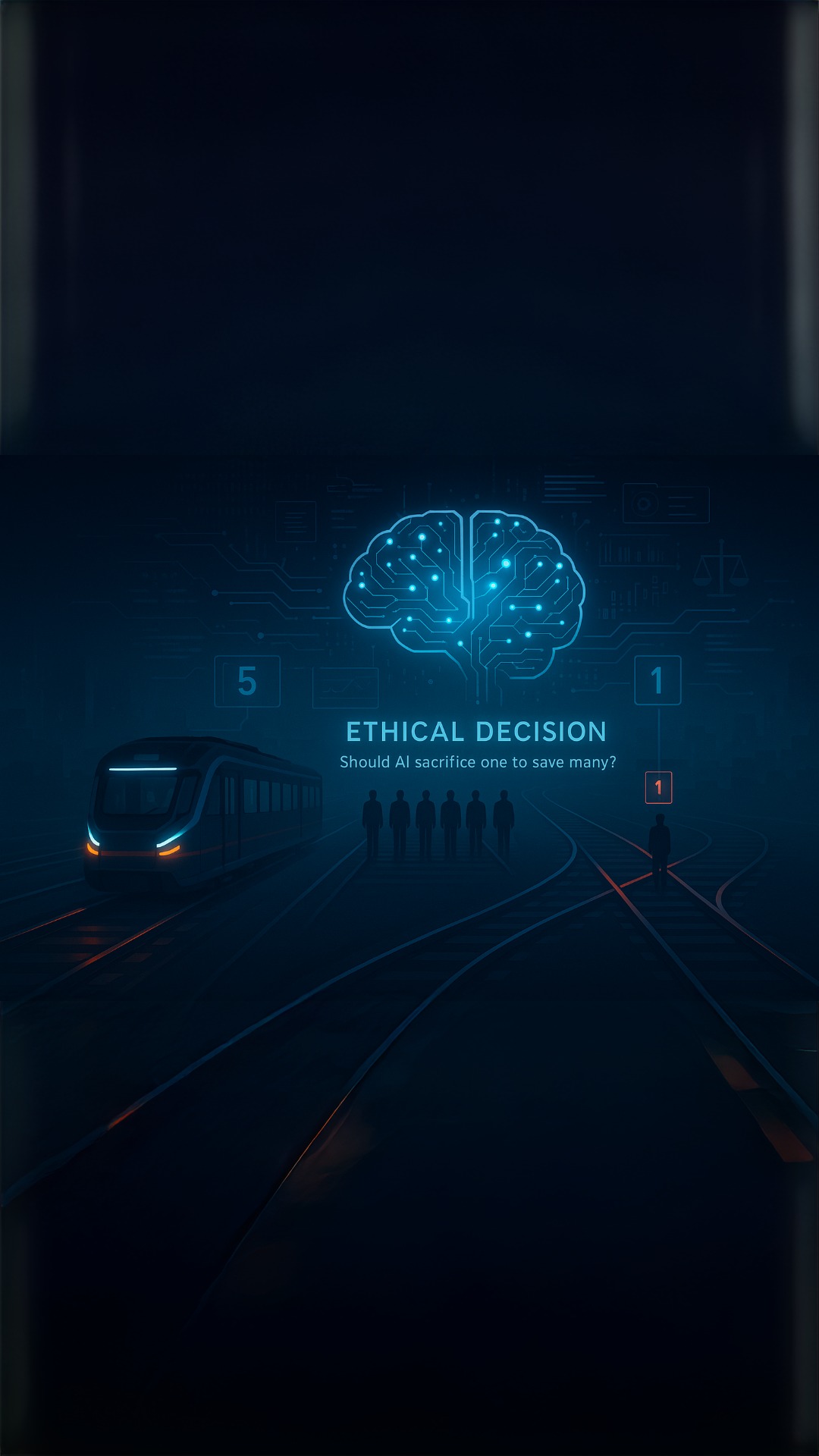
Imagine a runaway train heading toward five people. You can pull a lever to divert it onto another track, but there is only one person there. What would you do?
But wait: what if that person were a child and the five were elderly? What if someone offered you money to pull the lever? What if you couldn't see the situation clearly?
What is the Trolley Problem? Formulated by philosopher Philippa Foot in 1967, this thought experiment presents a seemingly simple dilemma: sacrificing one life to save five. But the variations are endless: the fat man to be pushed off the bridge, the doctor who could kill a healthy patient to save five with his organs, the judge who could condemn an innocent person to stop a riot.
Each scenario tests our fundamental moral principles: when is it acceptable to cause harm in order to prevent greater harm?
This complexity is precisely what makes the ethics of artificial intelligence such a crucial challenge for our time.
The famous "trolley problem" is much more complex than it seems—and this complexity is precisely what makes the ethics of artificial intelligence such a crucial challenge for our time.
From the Philosophy Classroom to Algorithms
The trolley problem, formulated by philosopher Philippa Foot in 1967, was never meant to solve practical dilemmas. As the Alan Turing Institute points out, the original purpose was to show that thought experiments are, by their very nature, divorced from reality. Yet, in the age of AI, this paradox has taken on immediate relevance.
Why does it matter now? Because for the first time in history, machines must make ethical decisions in real time - from self-driving cars navigating traffic to healthcare systems allocating limited resources.
Claude and the Constitutional AI Revolution
Anthropic, the company behind Claude, has tackled this challenge with a groundbreaking approach called Constitutional AI. Instead of relying solely on human feedback, Claude is trained on a "constitution" of explicit ethical principles, including elements from the Universal Declaration of Human Rights.
How does it work in practice?
- Claude self-critiques and revises its own responses
- It uses "Reinforcement Learning from AI Feedback" (RLAIF)
- It maintains transparency about the principles guiding its decisions
An empirical analysis of 700,000 conversations revealed that Claude expresses over 3,000 unique values, from professionalism to moral pluralism, adapting them to different contexts while maintaining ethical consistency.
The Real Challenges: When Theory Meets Practice
As brilliantly illustrated by Neal Agarwal's interactive project Absurd Trolley Problems, real ethical dilemmas are rarely binary and are often absurd in their complexity. This insight is crucial to understanding the challenges of modern AI.
Recent research shows that AI's ethical dilemmas go well beyond the classic trolley problem. The MultiTP project, which tested 19 AI models in over 100 languages, found significant cultural variations in ethical alignment: the models are more aligned with human preferences in English, Korean and Chinese, but less so in Hindi and Somali.
Real challenges include:
- Epistemic uncertainty: Acting without complete information
- Cultural bias: Different values across cultures and communities
- Distributed accountability: Who is responsible for AI decisions?
- Long-term consequences: Immediate vs future effects
Human Ethics vs. AI Ethics: Different Paradigms, Not Necessarily Worse
An often overlooked aspect is that AI ethics may not simply be an imperfect version of human ethics, but a completely different paradigm—and in some cases, potentially more consistent.
The "I, Robot" Case: In the 2004 film, detective Spooner (Will Smith) distrusts robots after being saved by one in a car accident, while a 12-year-old girl was left to drown. The robot explains its decision:
"I was the logical choice. I calculated that he had a 45% chance of survival. Sarah only had an 11% chance. That was somebody's baby. 11% is more than enough."
This is exactly the kind of ethics AI operates on today: algorithms that weigh probabilities, optimize outcomes, and make decisions based on objective data rather than emotional intuition or social bias. The scene illustrates a crucial point: AI operates on ethical principles that are different but not necessarily inferior to human ones:
- Mathematical consistency: Algorithms apply criteria uniformly, without being influenced by emotional or social bias - exactly like the robot calculating survival probabilities
- Procedural impartiality: They don't automatically favor children over the elderly or the rich over the poor, but evaluate each situation based on available data
- Decision-making transparency: The criteria are explicit and verifiable ("45% vs 11%"), unlike often opaque human moral intuition
Concrete examples in modern AI:
- AI healthcare systems that allocate medical resources based on probability of therapeutic success
- Matching algorithms for organ transplants that optimize compatibility and survival probability
- Automated triage systems in emergencies that prioritize patients with higher chances of recovery
But Maybe Not: The Fatal Limits of Algorithmic Ethics
However, before celebrating the superiority of AI ethics, we must confront its intrinsic limitations. The "I, Robot" scene that seems so logical hides deep problems:
The Lost Context Problem: When the robot chooses to save the adult instead of the girl based on probabilities, it completely ignores crucial elements:
- The social and symbolic value of protecting the most vulnerable
- The long-term psychological impact on survivors
- Family relationships and emotional bonds
- The yet unexpressed potential of a young life
The Concrete Risks of Purely Algorithmic Ethics:
Extreme Reductionism: Turning complex moral decisions into mathematical calculations can strip human dignity out of the equation. Who decides which variables count?
Hidden Biases: Algorithms inevitably incorporate the biases of their creators and training data. A system that "optimizes" could perpetuate systemic discrimination.
Cultural Uniformity: AI ethics risks imposing a Western, technological, and quantitative view of morality on cultures that value human relationships differently.
Examples of real challenges:
- Healthcare systems that could apply efficiency criteria more systematically, raising questions about how to balance medical optimization and ethical considerations
- Judicial algorithms that risk perpetuating existing biases on a larger scale, but that could also make already-present discrimination more visible
- Financial AI that can systematize discriminatory decisions, but also eliminate certain human biases tied to personal prejudice
Criticism of the Traditional Paradigm
Experts like Roger Scruton criticize the use of the trolley problem for its tendency to reduce complex dilemmas to "pure arithmetic," eliminating morally relevant relationships. As a TripleTen article argues, "solving the trolley problem won't make AI ethical" - a more holistic approach is needed.
The central question becomes: Can we afford to delegate moral decisions to systems that, however sophisticated, lack empathy, contextual understanding, and human experiential wisdom?
New proposals for balance:
- Hybrid ethical frameworks that combine computation and human intuition
- Human oversight systems for critical decisions
- Cultural customization of ethical algorithms
- Mandatory transparency on decision-making criteria
- Human right of appeal for all critical algorithmic decisions
Practical Implications for Companies
For business leaders, this evolution calls for a nuanced approach:
- Systematic ethical audits of AI systems in use - to understand both benefits and limitations
- Diversity in teams designing and implementing AI, including philosophers, ethicists, and representatives from different communities
- Mandatory transparency on the ethical principles embedded in systems and their rationale
- Ongoing training on when AI ethics works and when it fails
- Human oversight systems for decisions with high ethical impact
- Rights of appeal and correction mechanisms for algorithmic decisions
As IBM highlights in its 2025 outlook, AI literacy and clear accountability will be the most critical challenges for the coming year.
The Future of AI Ethics
UNESCO is leading global initiatives on AI ethics, with the 3rd Global Forum scheduled for June 2025 in Bangkok. The goal is not to find universal solutions to moral dilemmas, but to develop frameworks that enable transparent and culturally sensitive ethical decisions.
The key lesson? The trolley problem serves not as a solution, but as a reminder of the inherent complexity of moral decisions. The real challenge isn't choosing between human or algorithmic ethics, but finding the right balance between computational efficiency and human wisdom.
The AI ethics of the future will need to recognize its own limits: excellent at processing data and identifying patterns, but inadequate when empathy, cultural understanding, and contextual judgment are required. As in the scene from "I, Robot," the coldness of calculation can sometimes be more ethical - but only if it remains a tool in the hands of conscious human oversight, not a substitute for human moral judgment.
The "(or perhaps not)" in our title is not indecision, but wisdom: recognizing that ethics, whether human or artificial, does not allow for simple solutions in a complex world.
Sources and Insights
Initial Inspiration:
- All The Trolley Problem - Clarified Mind (Video)
- Absurd Trolley Problems - Neal Agarwal (Interactive Project)
Academic Research:
- Constitutional AI: Harmlessness from AI Feedback - Anthropic
- Language Model Alignment in Multilingual Trolley Problems - ArXiv
- "Pull or Not to Pull?": Investigating Moral Biases in LLMs - ArXiv
Industry Analyses:
- Claude's Constitution - Anthropic
- AI Ethics and Governance in 2025 - IBM
- AI's Trolley Problem Problem - Alan Turing Institute
Regulatory Developments:
Comments
No comments yet — start the conversation.