

Artificial intelligence can help a company consume less energy, reduce waste, and make ESG reporting less labor-intensive. But those who build AI products also know the other side of the story: every model runs on energy-intensive infrastructure, every API call has a computational cost, and the demand for computing power shows no signs of slowing down.
That is why sustainability in artificial intelligence should be treated neither as a slogan nor as a sin to atone for. It must be managed as an operational issue. In Italy, the debate has now centered on two specific concepts: “sustainability of AI ” and “AI for sustainability.” The first concerns the environmental footprint of AI itself. The second concerns the use of AI to improve processes, consumption, and environmental governance. In this same context, AI-supported ESG reporting has “nearly tripled over the past year,” according to this analysis on the sustainability of artificial intelligence and ESG governance.
As the founder of an AI company, I find both knee-jerk alarmism and complacent techno-optimism unproductive. The point isn’t to decide whether AI is “good” or “bad” for the environment. The point is to understand where it consumes resources, when it creates real value, and what concrete choices reduce its impact without undermining its usefulness.

The conversation about sustainability and artificial intelligence has matured. Finally. Not because the problem has been solved, but because it has become impossible to reduce it to a cliché.
On the one hand, AI helps companies and facilities use energy more efficiently, reduce waste, and streamline ESG reporting. On the other hand, these same systems require computing power, data centers, cooling, networks, and hardware components that have a real environmental cost. If you look at only one of these two sides, you’ll make the wrong decision.
The two categories I use most often are those that are now widely used in Italy as well:
The difference isn't just theoretical. It forces you to ask two different questions. The first is: How much does my AI stack weigh? The second is: Does that weight generate an environmental or operational benefit substantial enough to justify it?
The right question isn't "to use or not to use AI." The right question is "Does this task really require this much computing power?"
The mistake I see most often isn't technical. It's a decision-making mistake. Many companies adopt AI as if all the available power should always be used. In practice, they choose the largest model, the most complex workflow, and the most extensive automation—even when the problem was much simpler.
In reality, a sustainable strategy is based on a less spectacular principle: proportionality. If a task can be performed well with less computation, less data transfer, and less complexity, that’s not a compromise. It’s a better choice.
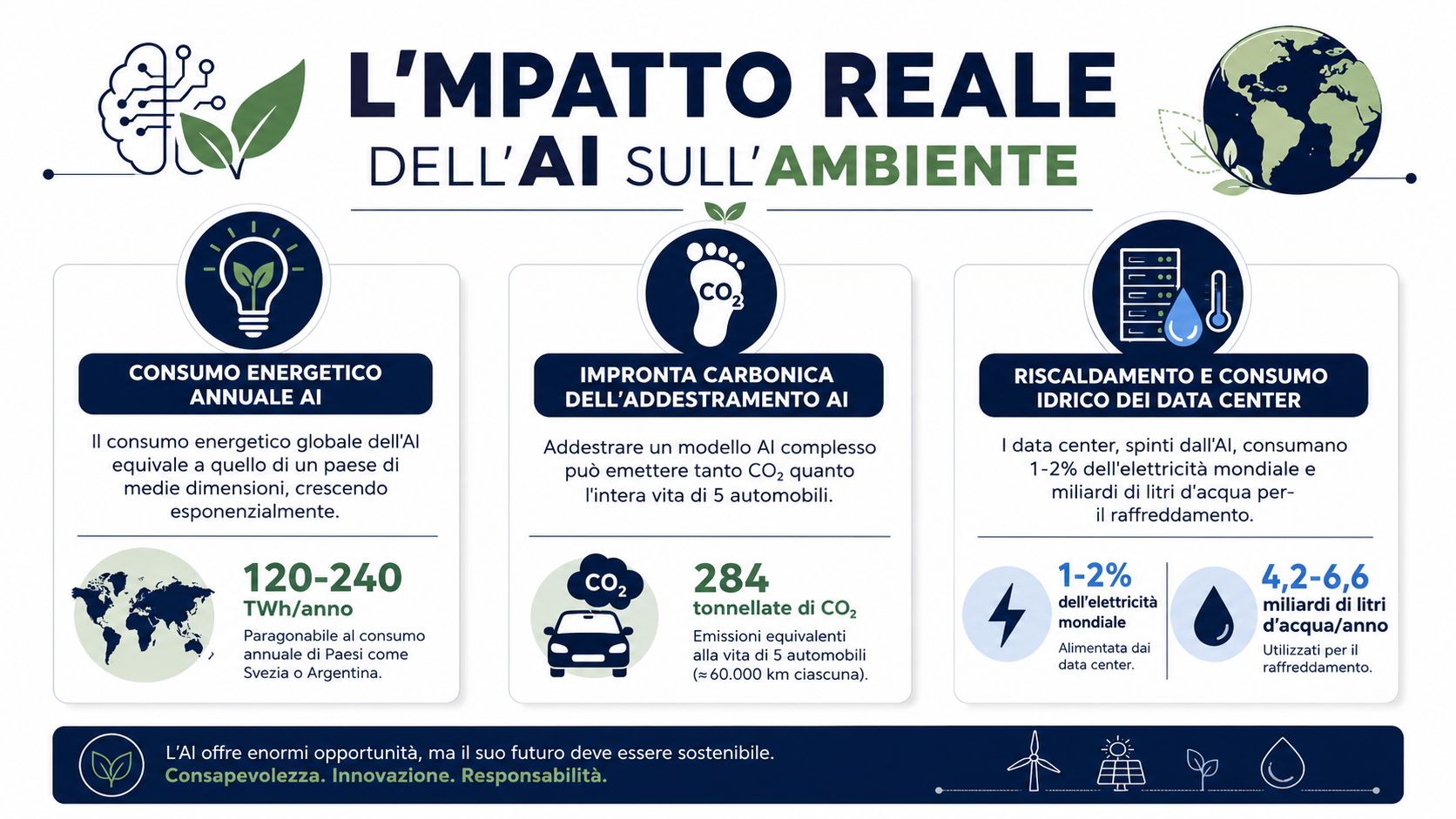
The most useful part of the discussion begins when we stop talking in abstract terms. The environmental impact of AI is not a matter of opinion. It is an infrastructure issue, and the data is already clear enough to warrant caution.
An Italian source citing international data reports that a 2019 study by the University of Massachusetts estimated that training a single AI model could generate over 284 metric tons of CO₂, equivalent to the emissions of five cars over their entire lifecycle. The same source reports that the development of ChatGPT-3 required approximately 1,287 MWh of electricity—equivalent to the annual consumption of about 120–130 average American households—and also cites a projection by Goldman Sachs Research suggesting that electricity demand from data centers could increase by 160%, with an increase of approximately 200 TWh per year between 2023 and 2030, while by 2028, AI-related consumption could reach 19% of data centers’ total energy needs. All of this data is reported in this Italian analysis on the environmental cost of AI.
The point isn't to use these numbers to spread fear through the media. The point is to understand the scale. If you build or adopt AI, you're contributing to a rise in energy demand that affects entire infrastructures—not just your cloud budget.
Rule of thumb: When evaluating an AI project, look beyond the cost per token or per API call. The real issue often lies upstream, in the infrastructure that makes that call possible.
Many people think that the environmental cost of AI is almost entirely due to training. This is a convenient oversimplification, but it is incorrect. Energy consumption is spread across multiple levels:
| Component | Why it matters |
|---|---|
| Training | It requires large amounts of concentrated computing power |
| Inference | Every user request generates repetitive work over time |
| Data Center | Power Supply, Redundancy, and Continuous Infrastructure Management |
| Cooling | The heat generated by the systems must be dissipated efficiently |
| Networks and Data Transfer | Moving data between systems, regions, and services consumes energy |
This changes the way we approach sustainability in artificial intelligence. It’s not enough to ask, “How much energy does the model consume?” You also need to ask where it runs, how much traffic it generates, how often it’s queried, and whether the architecture was designed to minimize waste.
That’s why it also makes sense to look at cases where AI is used to improve infrastructure. A useful example is theuse of AI to optimize energy efficiency in data centers, which clearly illustrates a simple point: the problem isn’t just the model, but the entire technical environment that supports it.
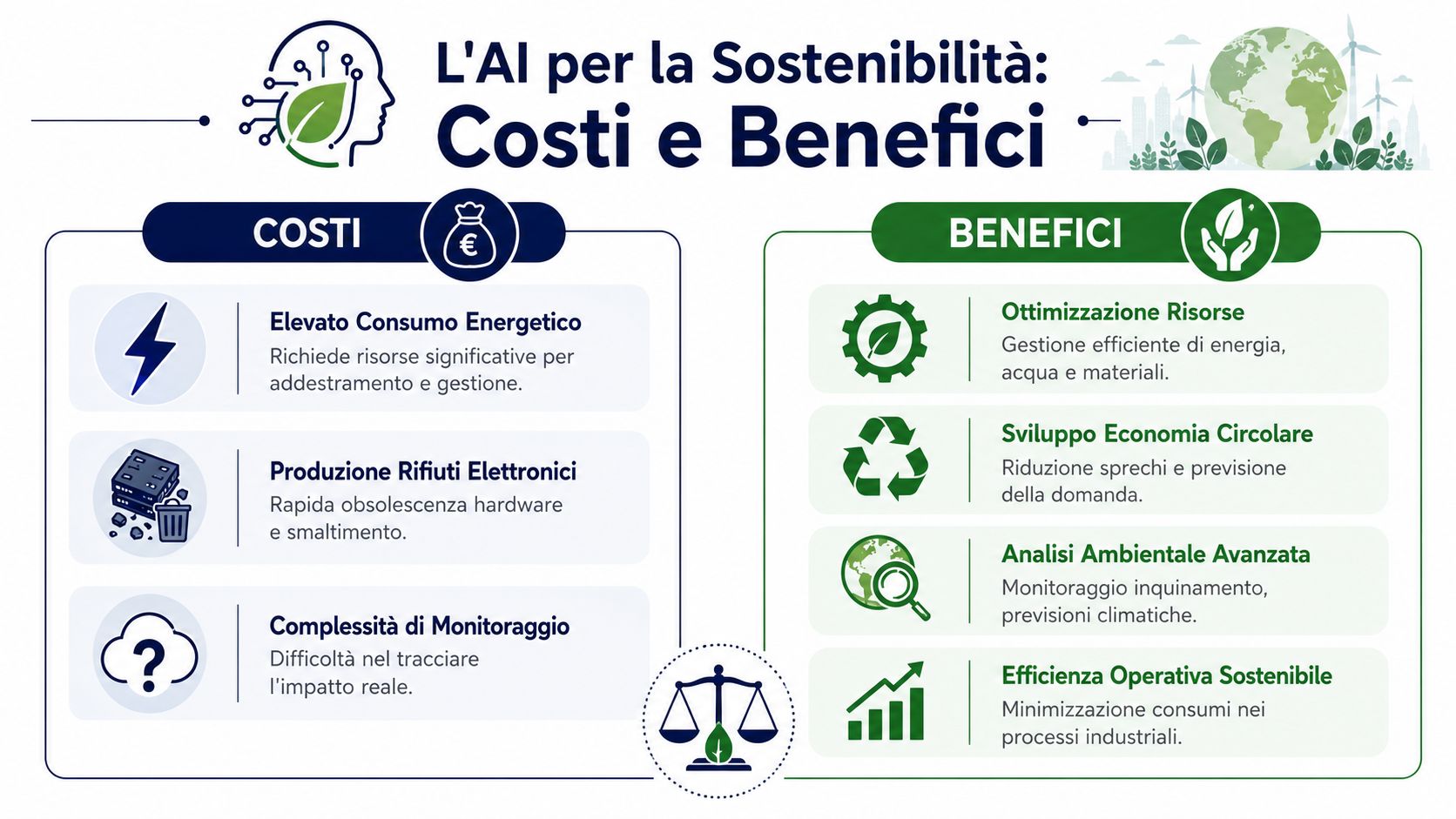
If you focus solely on costs, you’re missing half the picture. AI can also be a powerful tool for improving corporate sustainability—not just in theory, but through very concrete processes.
In the Italian context, when applied to energy management systems, AI can reduce operational energy consumption in industrial facilities and SMEs by predicting demand peaks and regulating loads such as HVAC and lighting in real time. This has a direct impact on Scope 2 emissions and helps optimize the use of intermittent renewable energy sources, as described in this in-depth article on AI-powered energy management systems.
This is the kind of application I consider justifiable even from an environmental standpoint. Not because it’s free, but because it uses computation to eliminate constant physical waste. In a facility with variable demand, adjusting ventilation, air conditioning, or lighting in real time can be worth more than a thousand slides on the green transition.
Here are three areas where AI tends to be truly useful:
For an SME, the benefit often doesn’t come from a spectacular model. It comes from a system that prevents duplicate work: manual exports, multiple Excel spreadsheets, attachments sent multiple times, and reconciliations performed by different people on the same data. All of this consumes time, resources, bandwidth, and attention.
A process that is repeated five times by different people is inefficient not only from an organizational standpoint but also from an environmental one.
When AI centralizes data, automates repetitive tasks, and makes analyses reusable, the environmental value does not lie in a single inference. It lies in the elimination of redundancy.
For those who work in reporting, a relevant example of this issue is ELECTE for ESG reporting, which helps illustrate how automation can reduce manual steps and information loss without turning every task into a complex IT project.

The encouraging thing is that the industry isn't standing still. AI is creating the problem, but it's also driving innovations that aim to reduce its energy costs. However, we need to be honest: there is no single solution.
A promising direction is one that focuses on interconnects and infrastructure efficiency. When computing systems are waiting for data, installed computing power is underutilized. This is one of the reasons why next-generation hardware should be viewed not only in terms of performance, but also in terms of efficiency.
In the tech debate, proposals are circulating that focus on photonic connections, improved data transmission, and reduced power dissipation. The practical consideration—for those purchasing cloud services rather than chips—is different: choosing stacks that get more useful work done with less waiting time, less traffic, and less overhead.
This logic also applies beyond AI in the strict sense. Those who wish to think more broadly about less wasteful production models can find useful insights in these sustainable economic practices, especially when it comes to linking digital efficiency with the reduction of material waste in processes.
On the software side, the most interesting features are often less glamorous and more straightforward:
In my experience, this has been the decision with the greatest impact. The most effective change was not introducing some cutting-edge technology, but rather stopping the practice of using the most powerful model for everything. Classification, formatting, extraction of known patterns, and many support operations do not always require a state-of-the-art model. They require architectural discipline.
If the result for the user is the same, using fewer computations isn't a compromise. It's better design.
That’s why I often talk about “the right model for the right task.” In practice, this means creating a routing layer that assigns each operation to the appropriate power level. It’s a decision based on cost, but also on sustainability.
Those interested in exploring the connection between technical solutions and environmental impact may also want to read ELECTE’s article on AI and the environment, which highlights various case studies and areas of development without presenting them as miracle cures.
The most important objection is also the most uncomfortable one: making AI more efficient does not automatically guarantee a reduction in overall energy consumption. In fact, sometimes the opposite happens.
When computing becomes cheaper, more accessible, and faster, companies tend to use it more. More automation, more requests, more integrations, more processes—all because “it doesn’t cost much anyway.” This is the heart of the efficiency paradox.
That is why sustainability in artificial intelligence cannot be limited to better chips or more compact models. It must become a top priority. Certain questions should be asked before any implementation:
One of the most glaring gaps in the Italian debate is precisely this: the lack of standardized metrics and a holistic approach to measuring AI’s footprint throughout its life cycle—an issue highlighted in this systemic perspective on the sustainability of artificial intelligence.
The problem, then, is not to slow down innovation. It is to stop treating computing as a free and inexhaustible resource. Every organization should treat it the same way it treats its budget or its people’s time: as something to be allocated where it truly adds value.
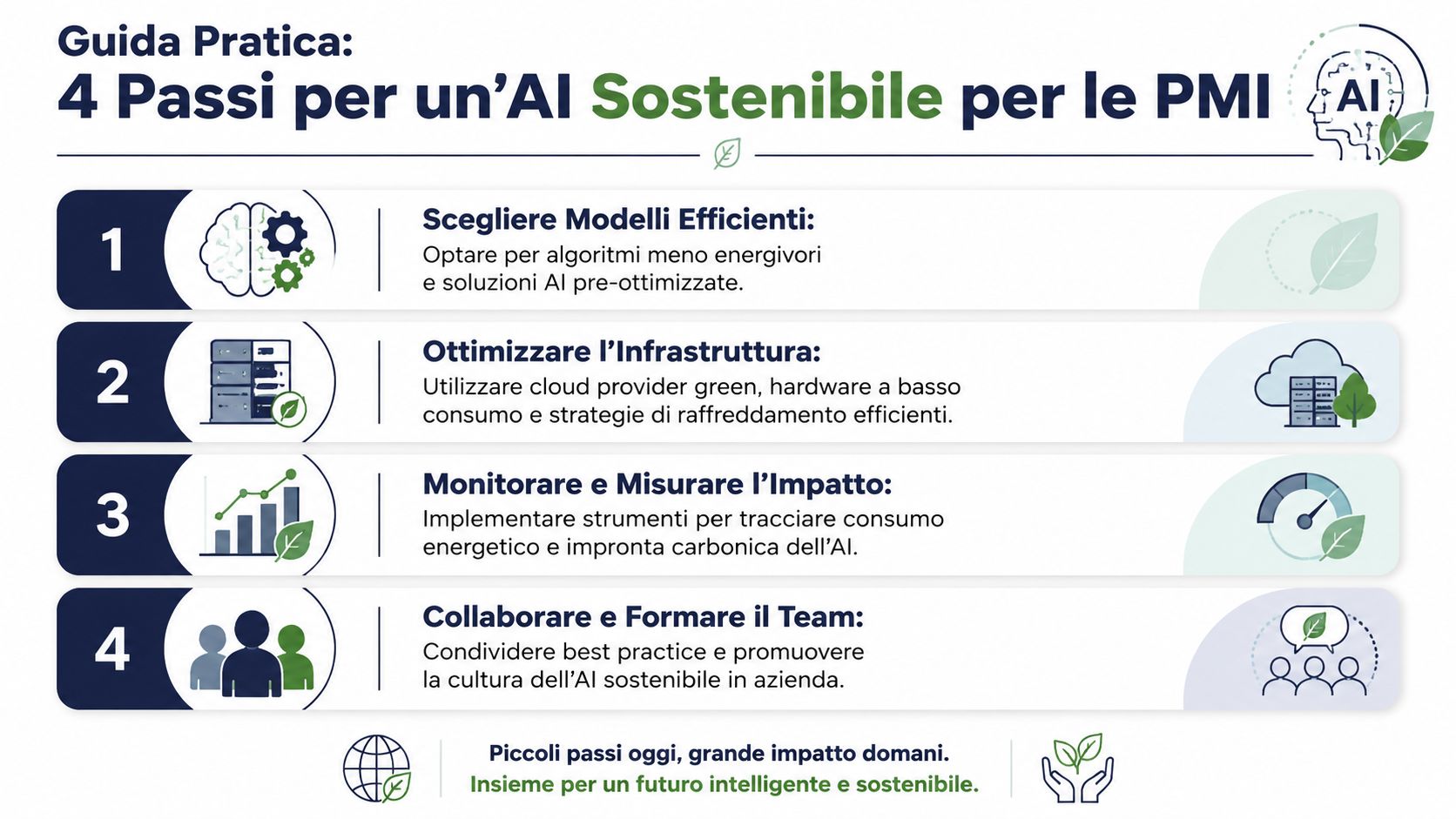
For an SME, talking about sustainability without an operational plan is of little use. It’s best to start with four decisions that can be made right away, even without a perfect measurement of the environmental footprint.
An Italian source notes that many discussions about the sustainability of AI overlook the cost-benefit trade-off, even though data centers already consume about 3% of the world’s energy. The often-overlooked question is: when does it make sense to use a smaller model or a traditional process to avoid an unsustainable increase in energy consumption and costs? This point is well summarized in this article on the environmental trade-offs of AI.
Choose a model that is appropriate for the problem
This is the lever that offers the best balance between simplicity and impact. Don't use the most powerful model by default. Use it only where it makes a real difference. For many everyday tasks, lighter models or non-generative systems are sufficient.
Evaluate the cloud provider based on its energy profile as well
Don't just look at price, latency, and compliance. Also consider transparency regarding data centers, the regional energy mix, and the approach to operational efficiency. Geography matters. A workload doesn't have the same footprint in every region.
Eliminate redundancy in workflows
If the same data is exported, copied, reformatted, and resubmitted multiple times, you’re wasting resources—even before we get to AI. A platform like ELECTE, an AI-powered data analytics platform for SMEs, can be used to centralize data, automate reports, and reduce duplicate analysis. The benefit, in this context, isn’t “doing more AI.” It’s doing less unnecessary work.
It measures, even if imperfectly
Not all companies have the tools to measure kWh or CO₂ per individual process. That's okay. Start with the operational metrics you already have at your fingertips.
In the absence of a truly established industry standard, I would start with a simple table:
| Operational metric | What does it tell you? |
|---|---|
| API Calls for Completed Tasks | If you're putting in too much work to get a result |
| Average model size per operation | If you're making your tasks too big |
| Data volume transferred per session | If your workflow generates avoidable traffic |
| Reports Generated but Not Used | If you're automating output that no one reads |
Measuring poorly but consistently is better than not measuring at all.
If, after three months, you notice that the number of calls per task is decreasing, that large models are being triggered less often, and that data transfer is lower, you still don’t have a perfect carbon accounting system. However, you do have something very useful: an efficiency framework that reduces computational waste, costs, and likely environmental impact as well.
The sustainability of artificial intelligence cannot be addressed with a slogan. Nor can it be addressed by an ideological rejection of AI. It is built through better technical and managerial decisions.
Anyone using AI today must balance two realities. The first: the environmental cost is real, it is growing, and it should not be downplayed. The second: AI can deliver tangible benefits when it reduces waste, improves energy efficiency, and replaces repetitive and disorganized processes with smarter systems. The quality of the decision lies in the balance between these two aspects.
For European companies, there is also a second level of responsibility. It’s not enough to simply be compliant. It’s necessary to understand how technology, infrastructure, governance, and intellectual property are intertwined. On this last point, for those who wish to delve deeper into the legal framework surrounding the adoption of AI, I recommend this guide on artificial intelligence patents, which is useful for viewing technological sustainability as a long-term strategic choice as well.
The right approach isn't to use less AI overall. It's to use the right AI, in the right place, at the right level of capability.
If you want to adopt AI more efficiently and with greater awareness, check out how ELECTE works. The platform helps SMEs centralize data, automate reports, and reduce redundant analytical work, with a pragmatic approach to model selection and operational efficiency.

.svg)


.svg)
.svg)