What Is Risk Assessment and Why It Matters in 2026
Learn what is risk assessment, how it works step by step, and why AI-driven monitoring is reshaping how SMEs manage financial and operational risk in 2026.

Risk assessment is a structured process that identifies potential threats, estimates their likelihood and impact, and guides treatment decisions so you act on evidence rather than instinct. In formal terms, it has become a repeatable discipline for turning uncertainty into priorities, not a one-off judgment call.
You may already be doing a version of it when you approve a supplier, launch a campaign, or sign off a new system. The difference is whether you're relying on a gut feel or using a process that lets you compare risks, document the reasoning, and revisit the decision when conditions change.
A Working Definition You Can Use Today
A small operations manager once chose a vendor because the name was familiar and the pitch sounded solid. Six months later, a missed financial filing pointed to trouble that could have been spotted earlier, before the contract was signed and the work was already under way.
That's the gap what is risk assessment is meant to close. A formal assessment asks what could go wrong, how likely it is, how severe the effect would be, and what you should do about it, which is why it starts with identification, moves into analysis and evaluation, then ends in treatment decisions.
The four pieces that make it usable
Identification names the threat. Analysis estimates how it could happen and how big the effect could be. Evaluation compares that result against your criteria or appetite. Treatment decides whether to avoid, reduce, transfer, or accept the risk.
That structure matters because it stops teams from mixing up a vague concern with a decision. The same logic works whether you're reviewing a software vendor, opening a new sales channel, or checking a marketing partner. A practical resource like UK fleet driver risk management shows the same idea in a different setting, where the task is to identify exposure before it turns into avoidable loss.
Practical rule: if you can't explain the threat, the likelihood, the impact, and the action in plain language, you don't have a complete assessment yet.
For teams that need a repeatable workflow, the ELECTE risk assessment page reflects the same logic in a business context. The point isn't to make risk sound complicated. It's to make the decision defensible.
How Risk Assessment Became a Formal Discipline
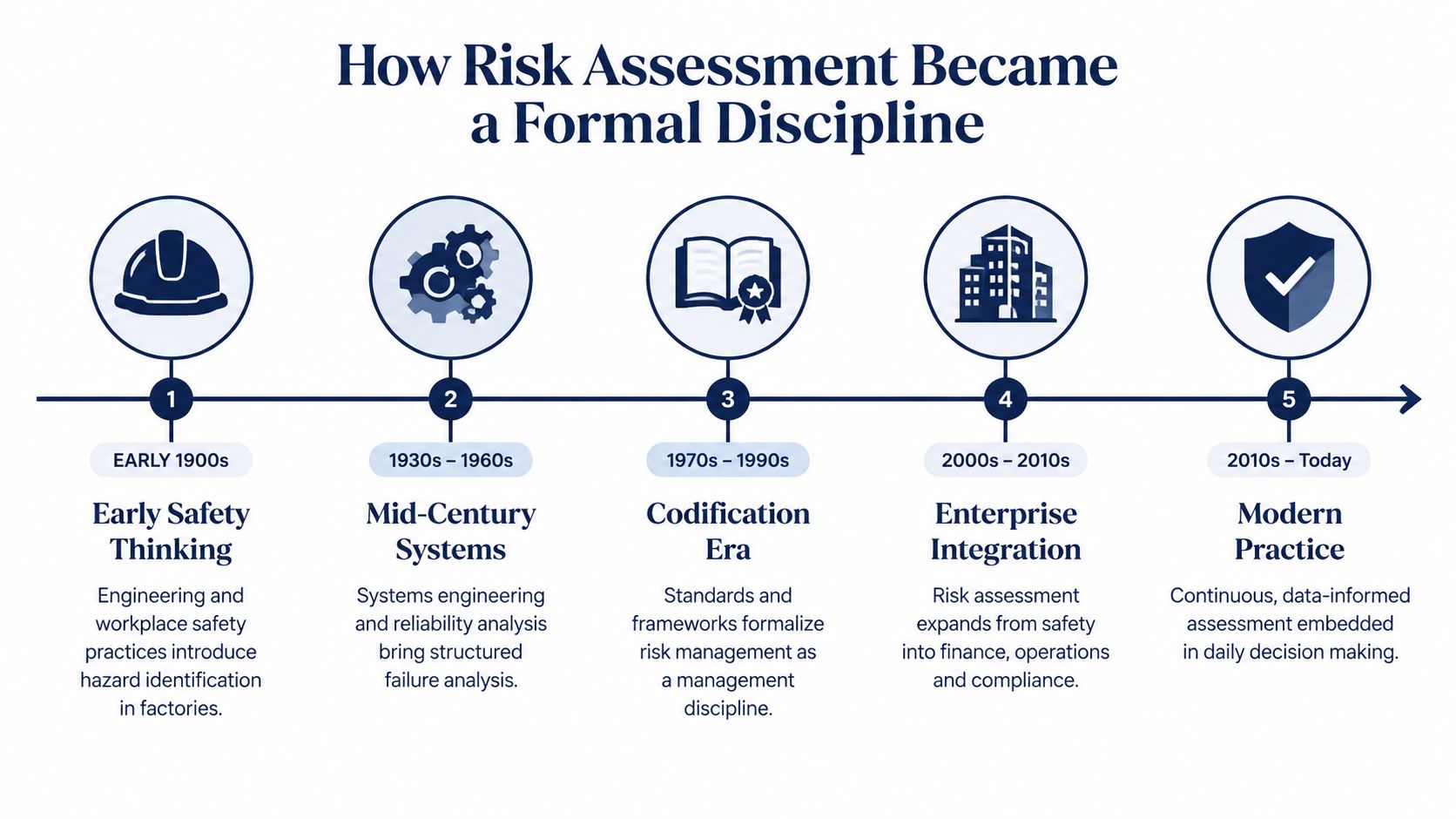
A practical assessment did not begin in boardrooms. It began where failure had visible consequences, in safety, engineering, and public health, then spread into policy, finance, and operations as organizations needed a repeatable way to compare one risk with another.
A major turning point was the National Research Council's 1983 Risk Assessment in the Federal Government: Managing the Process, often called the Red Book. It helped define the steps that still shape modern practice PubMed summary of the Red Book's historical role. In occupational health, ISO 1999 also showed how the field moved toward more structured, quantitative methods for estimating noise-related hearing loss from exposure data. Later, NIOSH published formal guidance, NIOSH Practices in Occupational Risk Assessment, which showed the method had become established rather than improvised.
Why that shift matters for business
Modern guidance describes risk assessment as a systematic process that identifies risk sources, threats, hazards, and opportunities, estimates how they could occur, and evaluates significance against relevant criteria SRA fundamental principles. That turns risk work into a workflow, not a gut check.
The same principles also place assessment inside a wider cycle of context setting, identification, analysis, response planning, and monitoring. They treat statistical and Bayesian methods as normal tools in that process. For businesses, the practical point is simple. You are not asking whether everyone feels comfortable with the decision. You are asking what evidence supports it, and what will change your view when new evidence arrives.
Risk assessment is not the same as gap analysis. Gap analysis asks where current performance falls short of a target. Risk assessment asks what could happen, how likely it is, and how large the impact would be if it does. A retailer can have a clear gap between current and desired reporting, while the actual risk may sit in payment fraud, supplier concentration, or customer data leakage.
That difference matters more as monitoring becomes continuous. Annual assessments can feel like a snapshot. AI-driven monitoring turns the process into live signals, which fits how SMEs operate, with changing suppliers, shifting demand, and faster decisions. The timeline below shows how the discipline moved from early formal work to the present A timeline graphic showing the evolution of risk assessment as a formal discipline from the 1900s to today.
The Three Core Steps Inside Every Assessment
A mid-sized retailer planning a new online sales channel gives a practical example. The team starts with the exposures that could affect the launch, then works through them in order.
Step one, identification
The retailer lists specific sources of exposure, such as supplier concentration, payment fraud, currency exposure, regulatory change, and customer data leakage. That list is the risk inventory, not the conclusion.
ISO 31000 treats this as the first stage of risk assessment, after the organization defines scope, context, and criteria ISO 31000 framework overview. If a material risk never enters the list, later analysis only becomes faster in the wrong direction.
Step two, analysis and evaluation
Once the risks are named, the team estimates how each one could occur and what it could cost. ISO 31000-based guidance says analysis should consider the source of risk, the area of impact, the event, its causes and consequences, whether the source is internal or external, the likelihood, and the controls already in place ISO 31000 risk management basics.
Evaluation comes after that. The team compares the results with formal criteria, including legal and regulatory requirements, so it can decide which risks need treatment and which can be accepted ISO 31000 framework overview.
A simple way to keep the sequence clear is this:
- Identify the exposures tied to the new channel.
- Analyze how likely each one is, and how bad the outcome would be.
- Evaluate the result against appetite, compliance needs, and business priorities.
That order matters because it separates discovery from judgment. A risk register is not a to-do list. It is a decision map, while gap analysis asks a different question entirely, where current performance falls short of a target.
Turning Risk Into a Score You Can Act On
A score is useful when it helps you compare one exposure with another. That's why many teams use a matrix that combines likelihood and consequence into a simple rating.
How the score works in practice
The idea is straightforward. On one axis, you rate how likely the event is. On the other, you rate how severe the consequence would be. Practical risk matrices often use 4-point or 5-point scales, and they convert the combination into a ranked score that supports prioritization FMEA-based risk assessment overview.
For example, a phishing email reaching an accounts payable clerk might land in a higher-priority band than a server room flood if the flood controls are already strong and the phishing path is weakly controlled. The score isn't the verdict, it's the signal that helps you decide where to act first.
Likelihood | Consequence | Combined Score | Required Control Level |
|---|---|---|---|
Low | Low | Low | Monitor and review |
Low | High | Medium | Strengthen controls where feasible |
High | Medium | High | Add targeted controls promptly |
High | High | Critical | Treat immediately with strongest feasible control |
Why the score leads to the control choice
Workplace safety uses a control hierarchy that ranks responses from elimination and substitution down to engineering controls, warnings, administrative controls, and PPE ASSP and CCOHS hierarchy summary. That order matters because the safest control is usually the one that removes the hazard at the source.
Score the risk first, then ask what control level matches it. Don't start with the control you already own.
For teams wanting to understand the mechanics behind scenario-based scoring, how Monte Carlo simulation works is a useful next step because it shows how probabilistic thinking can support more detailed decisions. In most SMEs, though, a simple matrix is enough to separate urgent exposures from manageable ones.
Risk Assessment Versus Gap Analysis
A lot of confusion starts when people use risk assessment and gap analysis as if they mean the same thing. They don't.
A GDPR example makes the difference clear. Risk assessment starts with the data you hold and asks what could go wrong, how likely it is, and how severe the impact would be. That gives you a prioritized list, maybe a customer database breach, maybe a lost unencrypted laptop, maybe a weak third-party processor.
Same scenario, different question
Gap analysis starts with the GDPR requirements and asks what controls you already have versus what's missing. The output looks different. Instead of a threat list, you get a remediation list, such as no DPO appointed or a retention policy missing.
That's why mature programs use both. Risk assessment is forward-looking and threat-driven. Gap analysis is standard-driven and backward-looking. One tells you where exposure lives. The other tells you where your controls fall short.
Use risk assessment when you need to decide what matters most. Use gap analysis when you need to prove what's missing.
If you're unsure which one to start with, use this rule: assess the risk first, then test the control gaps that matter most. That sequence keeps you from wasting time closing low-priority gaps while a high-impact exposure stays live.
Risk Assessment in Finance and Retail
The same logic works whether you're lending money or selling clothes. The details change, but the structure doesn't.
Finance puts the method on credit exposure
A regional lending cooperative reviews its consumer book and notices rising default probability among self-employed borrowers after macroeconomic signals shift. The team tightens underwriting thresholds and reviews exposure caps, because the assessment gave them a clear signal before losses became obvious.
Formal assessment earns its keep by forcing the lending team to name the exposure, rank it against tolerance, and attach an action with an owner and a review date. Without that structure, the discussion stays vague and the response arrives too late.
Retail uses the same logic for inventory and promotions
An independent fashion retailer applies the same approach to inventory and promotions. It identifies stockout and overstock risk on seasonal lines, analyses last year's sell-through data and supplier lead times, then evaluates which SKUs deserve higher safety stock and which ones need deeper markdowns.
The payoff is practical. The team uses the same decision structure in a different operating environment, which is exactly why risk assessment travels so well across functions.
The common thread is simple:
- Name the risk before you debate it.
- Score the likelihood and impact before you debate the fix.
- Assign the treatment before the issue disappears into the next meeting.
How AI Is Reshaping Risk Monitoring
Traditional assessments often run on a quarterly or annual cycle. That works for stable environments, but it leaves gaps when transactions, suppliers, customers, and systems change every day. AI and automation narrow that gap by turning risk assessment into a continuous signal instead of a periodic review.
What changes when the data keeps flowing
With live data ingestion, pattern detection, and anomaly flagging, a team can monitor transactions, credit exposures, supplier performance, and customer behavior as they happen. Static spreadsheets lose signal when the volume grows, because a person can't keep rechecking every row fast enough to notice the pattern shift.
That's also where human review still matters. AI can rank alerts and highlight unusual activity, but someone has to validate the flag, interpret the context, and decide whether the issue is a real risk or just noise. For a deeper look at model and usage concerns, the article on LLM risk in analytics is a useful read because it shows why oversight still belongs in the process.
What SMEs need from the tooling
SMEs usually don't need a heavy risk office. They need a layer that connects to existing accounting or POS systems, surfaces ranked signals, and documents what changed so the review isn't lost in email. In that sense, ELECTE can sit alongside other monitoring tools as one option for turning operational data into automated reports, anomaly alerts, and recurring risk signals, especially when a team wants the process to stay lightweight.
For readers who want a practical visual on that idea, identifies errors and opportunities guide shows how anomaly detection can support faster review. The bigger point is that AI doesn't replace risk assessment. It keeps the assessment alive between formal meetings.
Key Takeaways and Your Next Steps
What is risk assessment in plain English? It's a structured way to identify threats, estimate likelihood and impact, score them against your criteria, and choose the right treatment. That's what turns a vague concern into a decision you can defend.
The second big shift is operational. AI now makes it possible to move from point-in-time reviews to live monitoring, so risk assessment can keep pace with SMEs that don't operate on a neat annual calendar. The third distinction is just as important, risk assessment asks what could go wrong, while gap analysis asks what's missing versus the standard.
Here are five actions you can take this week:
- List your top ten risks. Keep it concrete, no categories without examples.
- Score three of them with a simple 4x4 matrix. Use likelihood and consequence, then compare the result.
- Write one mitigation for each high-risk item. If you can't name the treatment, the score isn't finished.
- Assign an owner and a review date. Risk without accountability becomes background noise.
- Check your existing tools for monitoring potential. Look for accounting, POS, CRM, or workflow data you're already collecting.
The best first assessment is the one your team will actually update.
If you're still doing this by hand, that's a good sign that the process is ready for automation. Start with the data you already have, then look for ways to turn it into a live risk view instead of a static spreadsheet.
ELECTE helps SMEs turn business data into ranked signals, automated reporting, and continuous monitoring without forcing a heavyweight risk program. If you want a faster path from manual scoring to live oversight, visit ELECTE and see how it fits your workflow.
Comments
No comments yet — start the conversation.